
Grow, Create, Standardize
How Private Equity Bought Our “Economic Development Partner”

When I hear “private equity,” I picture Wall Street, not a grant administrator sitting in a courthouse in Montgomery County, Missouri.
But that’s exactly where the money leads.
Over the years, our counties have been told we “need help” managing federal money, recruiting jobs, and competing for mega-projects. So we hired “economic development partners” and grant administrators to recruit businesses and do just that.
What nobody told us is that our local consultant, MarksNelson, is now the founding piece of a private-equity backed platform called Springline Advisory, built by a Dallas firm named Trinity Hunt Partners.
In plain English, our rural ARPA mega-site is now part of a much bigger public/private business plan.
Let me walk through how that works. I hope once you see the structure, you can’t unsee it.
MarksNelson before the buyout
MarksNelson started life as a regional accounting and advisory firm based around Kansas City/Overland Park. They do all the normal CPA things including tax, audit, financial planning but they also built two niche superpowers:
Location & site strategy
They help companies pick locations: market screening, labor analysis, incentive modeling, community visits.Incentives & grants
They help businesses and communities design incentive policies, negotiate deals, and administer grants. They brag about helping governments secure and manage over $100 million in grant funds.
So even before private equity shows up, MarksNelson is sitting in a very powerful spot because they know where projects want to land (site selection). They know which communities are hungry enough to compete (economic development). They know how the federal and state money actually flows (grant administration).
That combination is rare. And lucrative. It positions the firm to earn fees across the whole lifecycle of a mega-project: helping communities pursue grants and incentives, then helping projects navigate the process those incentives create. When one firm sits at that junction, it doesn’t just “advise” it can shape the lane the rest of us are expected to drive in.
Enter Trinity Hunt – a private equity sponsor
Trinity Hunt Partners is a Dallas-based private equity firm with more than $2 billion under management. They specialize in business services and like to create “platforms” they can grow through acquisitions.
In 2023, Trinity Hunt invested in MarksNelson Advisory and announced that MarksNelson would be the anchor of a new advisory “platform.”
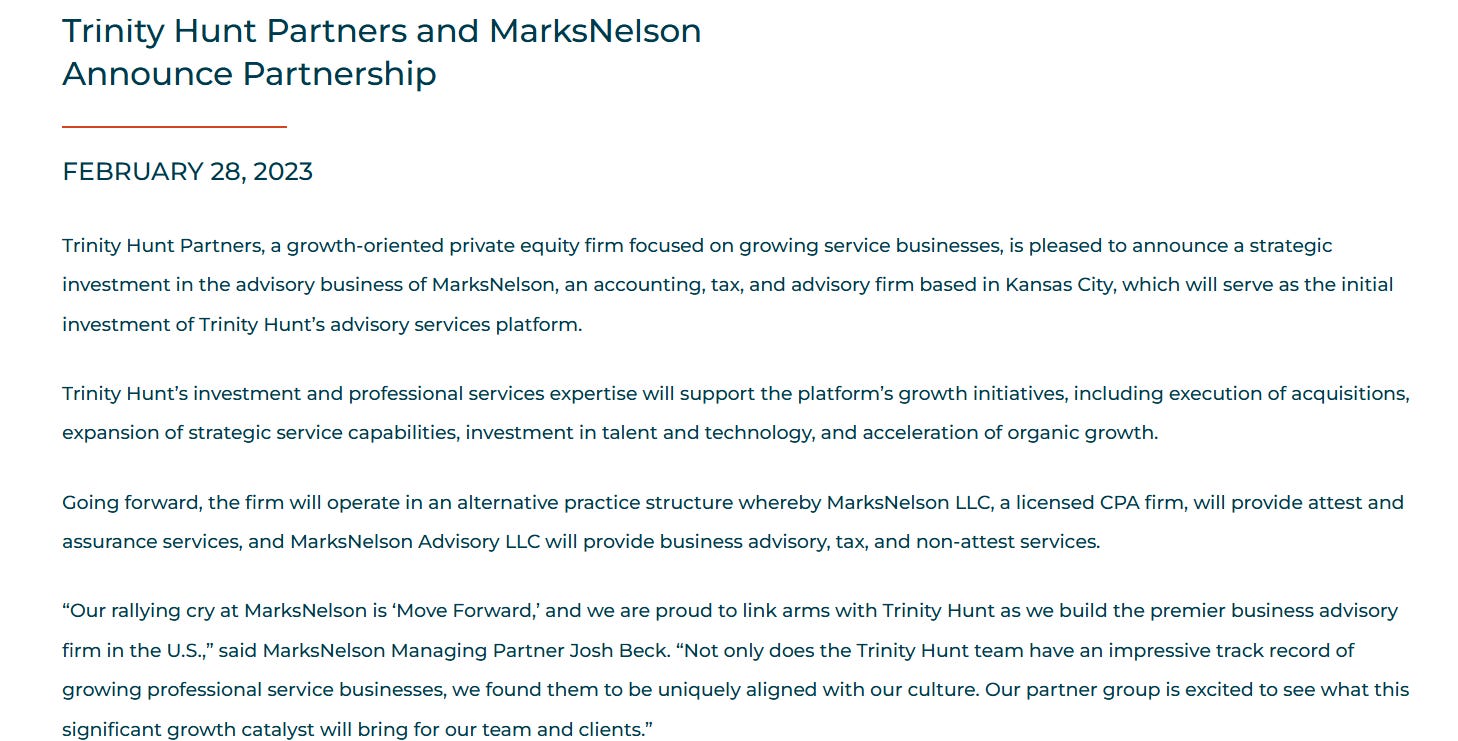
Their own press release says it plainly:
“We are thrilled to launch Trinity Hunt’s advisory services platform alongside the talented team at MarksNelson… as we look forward to executing our buy-and-build strategy.”

“Buy-and-build”. This means, they buy one strong firm to use it as the base layer. Then they add money, systems, and management. Next they start buying other firms and bolt them on to copy and paste, resulting in Trinity Hunt growing revenue fast.
The base firm becomes the platform.
What is Springline, really?
On their own site, Springline Advisory positions itself as a growth platform built around a “Scale + Soul” vision: the promise that clients can get the attentiveness of a smaller firm and the resources and reach of a larger one.
And Springline is explicit that this isn’t just branding it’s structure.
On the Springline leadership page for Josh Beck, he is identified as Managing Partner, MarksNelson Advisory, and Springline states that he is responsible for “leading the MarksNelson Advisory team that joined Springline in 2023.”
That single sentence matters, because it tells you MarksNelson didn’t simply “partner” informally. A MarksNelson advisory team joined a larger platform in 2023, and leadership roles were reorganized inside that new umbrella.
This is what a “platform” means in the private equity world: one firm becomes the anchor, then the platform adds more firms and capabilities over time—often through acquisition—so the overall organization can scale faster than any single regional firm could on its own.
Springline’s own legal language also clarifies the operating structure: Springline Advisory, LLC is not a licensed CPA firm; instead, services are provided through subsidiary or partner entities (and firms operate under alternative practice structures under professional standards).
So when a county signs a contract with “MarksNelson, a Springline company,” the county is not just hiring a standalone local consultancy. It’s hiring a firm that sits inside a national-scale advisory platform whose stated vision is to increase resources, reach, and future opportunities “to scale”.
How this intersects with ARPA and mega-sites
Now put this next to my FOIA documents. In 2023, Montgomery County signed an engagement letter with MarksNelson Advisory for:
“Project management and grant administration services for the Client’s ARPA Mega-Site project.”
The fee: $100,000, billed at $4,000 per month from August 2023 through September 2025. This is a flat admin fee.
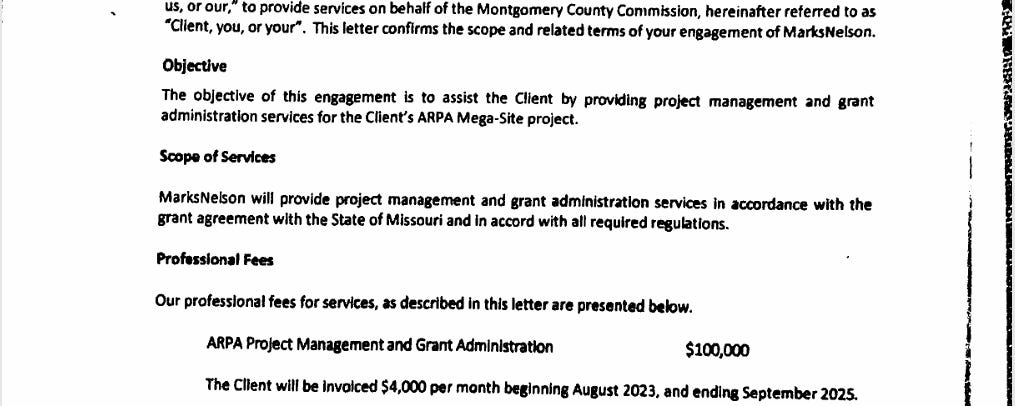
That contract makes MarksNelson:
The project manager
The grant administrator
The liaison to the State of Missouri
The person sitting in the middle of every ARPA decision on the mega-site.
At the exact same time, Springline is being built around MarksNelson as a growth platform.
From Trinity Hunt’s standpoint, this is perfect timing:
Federal money is flooding in (ARPA, IIJA, CHIPS).
Communities are overwhelmed by grant rules and compliance.
Mega-site and data center projects are popping up wherever there’s power and land.
Advisory firms that can “manage the chaos” are in high demand.
So they invest in MarksNelson, build Springline around it, and go hunting for more contracts like ours.
This isn’t secret. It’s in their own marketing:
MarksNelson says it helps governments “develop incentive policies, negotiate and structure incentive agreements, and secure and administer more than $100 million in grant funds.”
They also sell “location strategies” and “incentive modeling” to companies looking for sites.
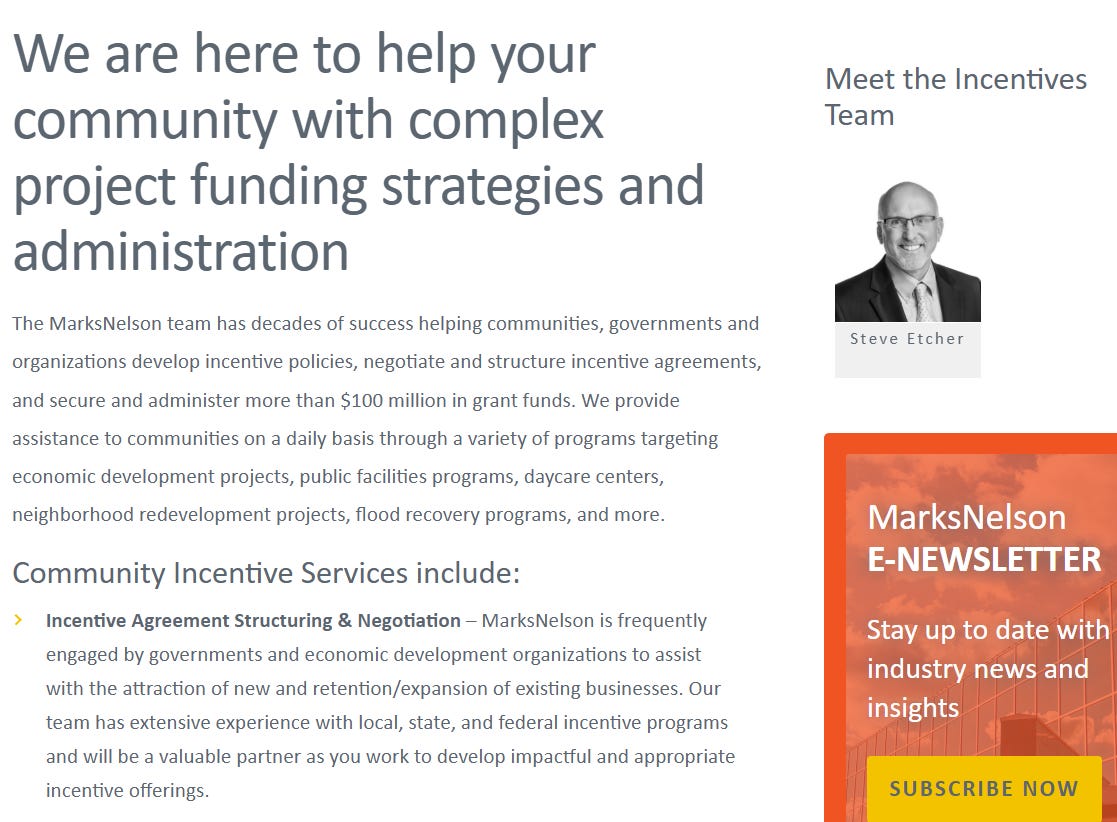
In other words, they work for both sides of the table:
Governments, as the grant administrator/economic development partner
Corporations and developers, as the site selection and incentives advisor
That dual role is the heart of the AI Factory Next Door problem.
Why private equity loves this business model
Private equity doesn’t care about one county. It cares about patterns.
This advisory niche has all their favorite ingredients.
Sticky, recurring revenue
Multi-year contracts (like our $4,000/month for two years).
Ongoing compliance work after the money is awarded.
“Economic development partner” retainers through EDCs and cities.
Scalable processes
Grant administration, incentive modeling, and mega-site packaging are repeatable.
Once you build the templates and playbooks, you can drop them into county after county.
A fragmented market
Lots of small firms and overworked communities.
Easy to roll up regional players into one big platform.
Massive federal tailwinds
ARPA, IIJA, CHIPS, energy transition money, and now grid upgrades for data centers.
Trinity Hunt and Springline’s own language confirms this. They talk openly about transforming the mid-market accounting industry, adding capabilities through acquisitions, and executing a buy-and-build strategy.
So from their point of view, every time a county like ours:
creates a mega-site,
applies for ARPA industrial infrastructure grants,
outsources grant management and “economic development” to a consultant…
…it’s not just a local project. It’s another building block in a national revenue platform.
This is bigger than MarksNelson
MarksNelson/Springline is not the only player.
Other large advisory firms (like CohnReznick) openly market themselves as grant management and infrastructure program managers for governments trying to navigate ARPA and IIJA. They highlight experience managing tens of billions in federal funds and offer cradle-to-grave services across the grant lifecycle.
This is now an industry:
Private consultants running public grant programs
Private equity, in some cases, backing those consultants
Local governments leaning on them because staff and capacity have been hollowed out
Our situation in Montgomery County—paying a PE-backed advisor to manage our ARPA mega-site—is not an isolated coincidence. It’s exactly the kind of arrangement the industry is built to scale.
What this does not mean, and our guardrails
For legal and ethical reasons it’s important to be precise about what this structure does and doesn’t prove. I have found no evidence so far that anyone broke the law, anyone took a personal kickback or that any one company secretly “controls” the federal government
It does mean a few things that need monitored:
The same firm (and its PE-backed platform) can profit from both sides of mega-projects: helping communities chase grants and helping corporations harvest incentives.
Our counties are increasingly dependent on a private platform to make sense of public money.
The people designing our “economic development strategy” answer, ultimately, to investors who want growth, scale, and deal volume.
That is a conflict-of-interest risk, even if everyone involved is polite and professional and technically compliant.
Control of process is control of outcome.
What communities should be asking for
If we’re going to work with firms like MarksNelson/Springline, we need stronger guardrails.
Here are the questions every county and city should be asking in public:
Who is your client on this project?
Are you representing any private company or developer who might use this mega-site while you are being paid by the county?
How are you paid?
Is any part of your compensation a “success fee” or tied to grant size, project closing, or incentive approvals?
How many public entities pay you on this same project?
County? EDC? City? Port Authority?
Who owns you?
Are you part of a larger platform?
Which private equity firm backs you?
What other firms in the network touch our region?
Who keeps the records?
Are all work products, memos, and models created for the county considered public records subject to our sunshine laws?
These are not conspiracy questions. They are basic due diligence when you invite a PE-backed platform into your budget, your zoning map, and your water table.
Why this belongs in the “AI Factory Next Door” story
Data centers and mega-sites are not just buildings.
They are:
Power contracts
Transmission upgrades
Water withdrawals
Tax structures and incentives
Long-term land use commitments
Behind all of that are advisors—and increasingly, those advisors are organized into platforms designed to scale across the whole country.
Our local ARPA mega-site grant is one tile in that mosaic.
The “AI Factory Next Door” is not just the building on the edge of town. It’s the financial and advisory machine that decides where those buildings land and who pays the bill.
If we don’t understand how private equity, Springline, and firms like MarksNelson fit into that machine, we’re not really at the table.
We’re just the ones signing the checks.